Menu Engineering: Find Your Stars, Plowhorses, Puzzles and Dogs
Menu engineering sorts each dish by two numbers, how often it sells and how much it earns per plate, into four groups: stars (keep), plowhorses (rework the cost), puzzles (promote) and dogs (remove). All you need is one period's sales and each dish's price and plate cost.
Menu engineering is a way of reading your sales so you know which dishes earn their place. It was set out by Michael Kasavana and Donald Smith in 1982 and is still the method most restaurant courses teach. You need two numbers for every dish, and a spreadsheet does the rest.
What you need
- The number of each dish sold over a period — a month is a good start. Your till or POS report has it.
- The menu price and the plate cost of each dish. If you have not costed your plates yet, start with menu pricing.
Analyse one menu section at a time — mains with mains, desserts with desserts. Comparing a coffee with a steak tells you nothing.
Step 1: Contribution margin
For each dish, contribution margin = menu price − plate cost. It is what the dish leaves you to pay for rent, staff and profit.
Then work out the section's average contribution margin: the total margin earned by the section (each dish's margin × number sold, added together) divided by the total number of dishes sold.
A dish is high-profit if its margin is above that average, low-profit if it is below.
Step 2: Popularity
Each dish's menu mix is its share of the section's sales: dishes sold ÷ total dishes sold in the section.
Kasavana and Smith set the popularity threshold at 70% of an equal share. With 10 dishes in a section, an equal share is 10%, so the threshold is 7%. A dish above 7% of sales counts as popular.
Step 3: The four groups
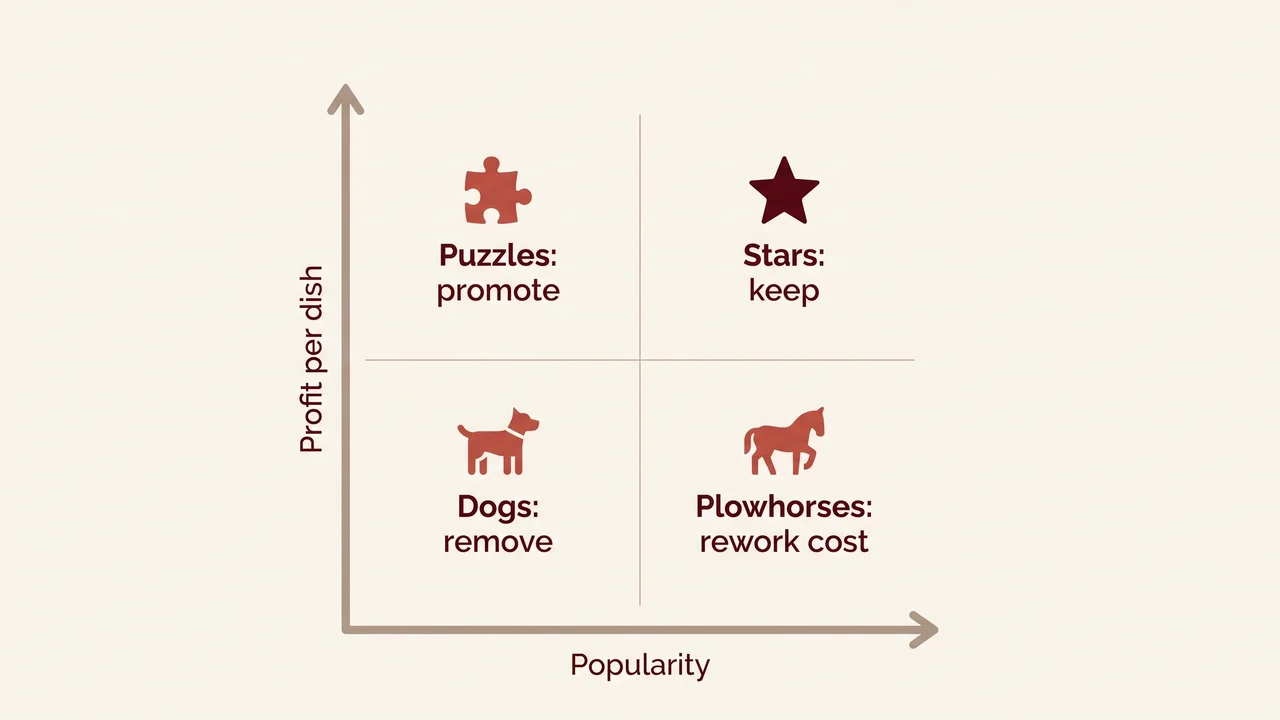
- Stars — popular and high-profit. Keep them exactly as they are, give them the best place on the menu, and be careful with price rises.
- Plowhorses — popular but low-profit. Guests love them, so do not remove them. Look at the recipe and portion first, then a small price rise, or pair them with a high-margin side.
- Puzzles — high-profit but not popular. Something stops guests ordering them: the name, the description, the position on the menu or the price. Rewrite the description, move the dish higher, mark it as recommended, or let staff suggest it.
- Dogs — neither popular nor profitable. Remove them unless there is a reason to keep one, such as the only vegan main.
Step 4: Change one thing, then measure again
Change a few dishes at a time and run the analysis again after the next period. If you rewrite every description, reprice half the menu and move everything around at once, you will not know what worked.
This is where a digital menu helps: moving a dish up, marking it as recommended or rewriting its description takes a minute, and there is nothing to reprint. On a QR code menu you can also see which dishes guests open, which tells you whether a puzzle is being seen at all.
Where menu engineering falls short
It looks at each dish alone. A low-margin dish that brings in a table ordering wine does not show its value in this matrix. It also ignores labour: a high-margin dish that takes the kitchen twenty minutes may cost more than it earns on a busy night. Use the matrix to ask better questions, not to decide automatically.
Frequently asked questions
How long a period should I analyse?
Long enough for normal sales to show — a month is a common starting point. Avoid periods distorted by a holiday or a closure, and compare the same menu version.
Should I remove every dog?
Not automatically. Keep a dish that serves a purpose the numbers cannot see, such as the only option for a dietary need. Remove the rest, or rework them.